From failure data to maintenance decisions.
Reliafy turns your reliability data into fitted life models, reliability block diagrams, and cost-optimal maintenance strategies — all in one place.
Life-distribution modelling
Fit Weibull, Lognormal, Exponential, Gamma, Normal, and proportional-hazards models to exact, censored, and truncated failure data. Probability plots with confidence bounds, goodness-of-fit, and a survival calculator.
Reliability block diagrams
Wire components in series, parallel, k-of-n, and standby on a drag-and-drop canvas to compute system reliability, MTTF, importance measures, and minimal path/cut sets.
Maintenance strategy
Rank every candidate distribution against your data, compare two designs head-to-head, and find the cost-optimal preventive-replacement interval.
Degradation & remaining useful life
Fit per-unit wear paths to a failure threshold, then track in-service items and predict when each will cross it — with credible intervals that tighten as inspections come in.
Evidence-linked RCM
Build Function → Failure → Mode worksheets where every maintenance decision cites the analysis that justifies it — and gets re-checked live when the data changes.
Your data, organised
Upload a CSV once and reuse it across models. Saved models reopen instantly, and everything is private to your account.
Maintenance decisions that prove themselves.
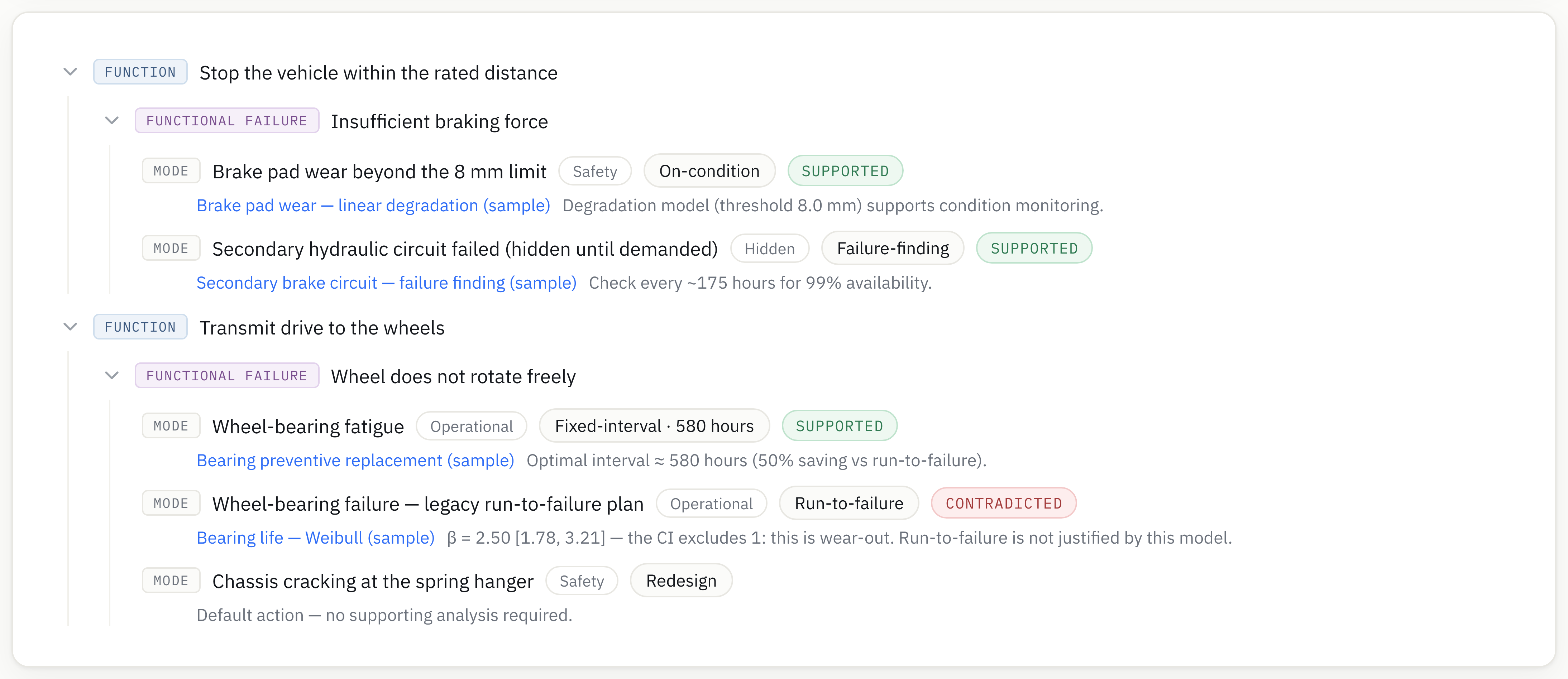
Every decision in an RCM study links to the analysis behind it: a run-to-failure call cites the life model that shows failures are random, a fixed interval cites the cost-optimal replacement analysis, condition monitoring cites the degradation model.
And the links stay live — when new data shows a "random" failure mode is actually wearing out, the study flags the decision as contradicted instead of letting it quietly go stale.
Know when it will fail — before it does.
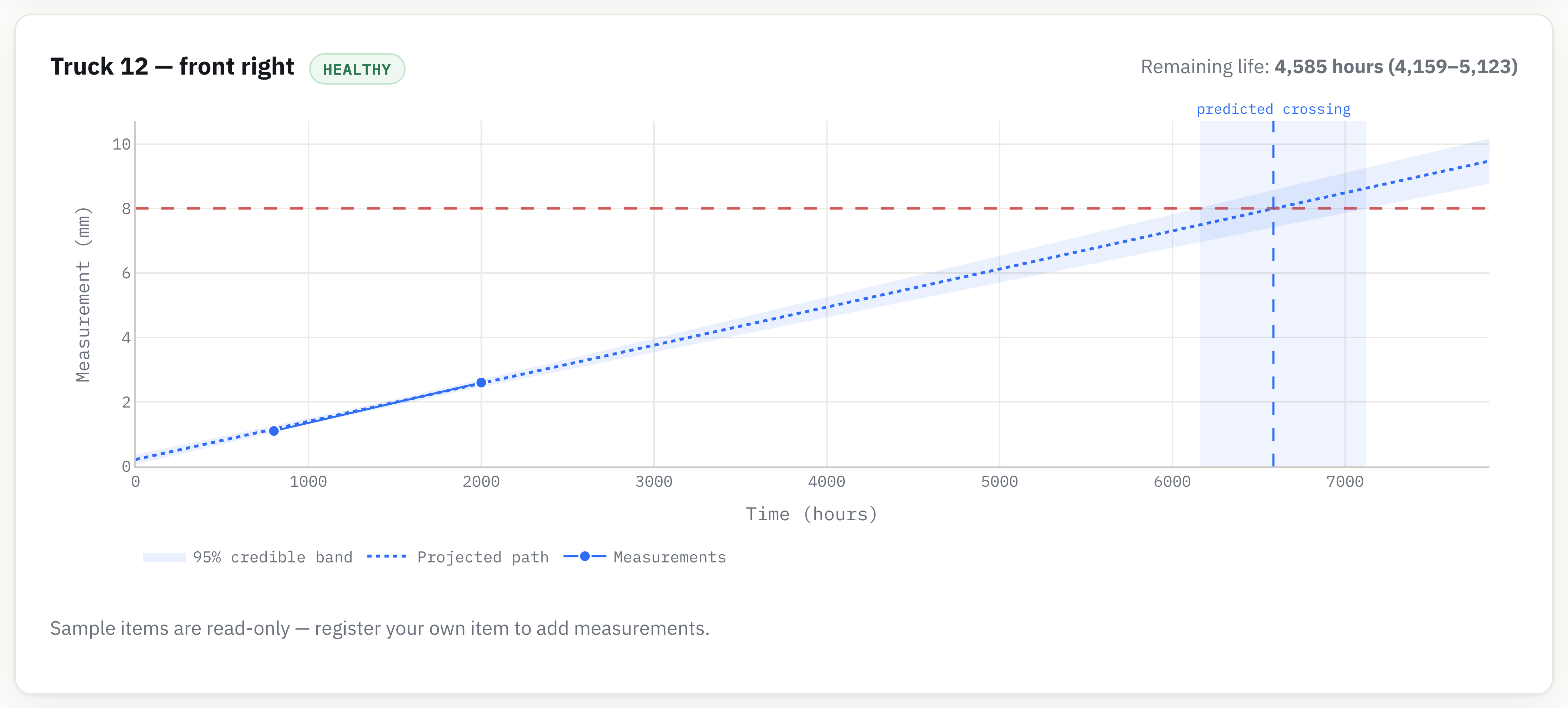
Your inspection sheets already contain the failure dates of equipment that hasn't failed yet. Fit a degradation model from historical wear data, register the items you're running today, and get a remaining-useful-life estimate for each one.
Every new reading tightens the prediction. Health badges turn from healthy to plan-replacement to replace-now while there's still time to act.
Work as a team
Shared team workspaces where everyone sees the same models, studies, and diagrams. Viewers are free; editing comes with Pro. Or share a single analysis, view-only, with anyone.
An assistant that does the work
Ask in plain language and the assistant acts in the app: fits models, builds RBDs, runs replacement calculations, tracks degradation, and drafts RCM studies — with your data, on your screen.
Open source at the core
The full toolkit is AGPL-licensed and self-hostable with one command, built on the open-source SurPyval and RePyability libraries. Your data can stay on your hardware; the cloud adds accounts, teams, and the assistant.
Free to run yourself. Effortless in the cloud.
The core is open source and always will be. The cloud adds accounts, the AI assistant, and zero setup.
Open source
Run Reliafy on your own hardware. Your data never leaves it.
- The full toolkit: modelling, RBDs, strategy, datasets
- Unlimited saves, single-user
- One-command install (docker compose)
- AGPL-3.0, source on GitHub
Cloud Free
The hosted app, ready in seconds. Everything you need to start.
- 3 saved datasets, 3 models, 1 RBD
- Degradation tracking: 1 model, 3 tracked assets
- 1 RCM study with live evidence validation
- 1 fleet failure forecast
- Join team workspaces free (view-only)
- Sample data and worked examples included
- 25 AI credits to try the assistant
- Try Reliafy from your AI agent: 20 tool calls a month
- Secure sign-in, private to your account
Pro
For working reliability engineers who live in their data.
- Unlimited datasets, models, and RBDs
- 1,000 AI credits included every month
- Unlimited fleet monitoring (degradation & RUL)
- Unlimited evidence-linked RCM studies
- Fleet failure forecasting — spares demand from your models
- Unlimited use from AI agents (MCP) — Claude or any MCP client
- API access — push meter data & measurements from your scripts
- Team workspaces: create teams and edit together
- AI assistant: fits models and builds RBDs for you
- Top-up credit packs from $5 — credits never expire
Enterprise
Reliafy across your organisation, with our team behind it.
- Everything in Pro, for every engineer in your organisation
- Dedicated support from the people who build Reliafy, with agreed response times
- Proactive monitoring of your data feeds, models and integrations, with alerts before a gap becomes a wrong answer
- Full graph access: ask questions across assets, maintenance history and failures that a table can't answer
- Guided onboarding: we help bring your data in and get your team productive
- Hosted in the region you need, on infrastructure we run for you
Built for reliability engineers.
Upload a CSV, fit a model, build a system, and decide when to act — in one place.
Get started